
Shut-off Moratoriums Would Limit Utility Scams
Updated: Jul 29, 2025
This month's Behind the Meter episode of the MPSC podcast discussed the pervasive topic of Utility Scams, a recently more popular approach that's been used against residents to fraudulently collect personal and financial information. This discussion hosted by Mike Burn featured MPSC Chair Dan Scripps and Monica Martinez, a nationally recognized expert in utility scams and a former member of the Michigan Public Service Commission. Martinez served on the commission from July 3, 2005 through September 2, 2011. She defines utility scams as people impostering utilities, "or government agencies or charitable organizations", letting victims know that they need access to their information to provide or maintain service.
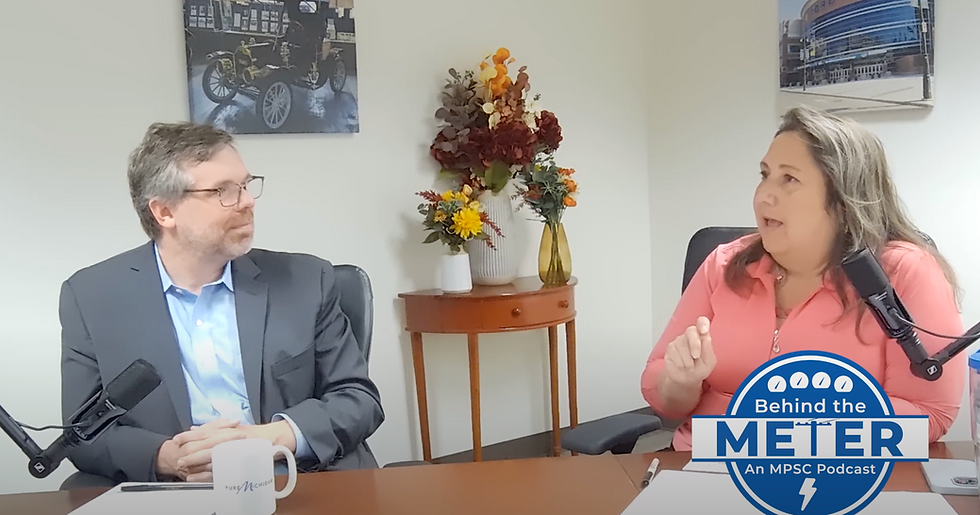
Scripps shares his surprise coming into the industry with the prevalence of utility scams saying, "Well that's where the money is and everybody has utility services…and as a result everybody has that utility bill that due." Utilities, unlike a UPS package, are a bill that people are always expecting and unfortunately are frequently concerned about the potential of being shutoff. Scripps continues, "People want to obviously avoid having their service shutoff, it is one of the things that feels like low hanging fruit if you're a scammer."
"No one wants to risk being shut-off" Martinez adds, "When people are busy doing other things ... that's just the prime circumstance for catching folks off-guard into thinking that they've missed a payment or they need to disclose information" just to avoid the potential of losing access to their essential utility. Burn adds on the exploitation of "fear or vulnerability", feelings that shouldn't be associated with ratepayers relationship to their utility, but often are. He pivots to ask if there’s any way that consumers can better recognize a utility scam.
Martinez' highlights scam tactics like feeling pressured or bullied by the caller, "That communication is usually pressuring somebody to do something immediately and they start to badger them 'if you don't do this you will lose that essential service'." She mentions that most companies typically aren't demanding immediate payment, social security numbers or account information and Dan reminds listeners to pay attention to that "gut feeling" saying, "is this the way that your utility usually interacts with you?"Unfortunately for many low income households with high energy burdens, paying more than 6% on combined utility costs, receiving threats of shutoff from the utility company isn't uncommon.
The tone for a shutoff notice, whether by postal mail, email or automated phone call carries a sense of urgency that is felt by the recipient naturally carrying discomfort, fear and pressure. Low income, elderly and even disabled rate payers are at higher risk of being shut off on any given day. As a result, these populations are at a much higher risk of falling victim to these types of scams. Dan suggests that for those questioning the legitimacy of shut-off notices to call their utility company using verified numbers. For some, prior negative experiences with their utility and conflicts with working schedules make this option less viable.

One may think locating their utility's verified number is as simple as a google search, but Martinez mentions a newer tactic that scammers are using to skew google results by paying for ads in order to be listed as the top result. "Last year we had a lot of search engine scams and those were items where individuals were falsifying or faking or saying this is how you pay a utility bill. We had this happen with many utilities across the country...and they were purchasing ads on many of the search engines and those were rising to the top". With technological advances developing faster, scammers are taking advantage of the ability to replicate all aspects of the utility company from site links to phone hold music and even recorded communications. Martinez emphasizes,"If you would've asked me 5 years ago I would have told you spelling errors, look at the salutation, look at the closing, the image is more grainy; I'm not even talking about that today."
Some resources shared with listeners included Utilities Against Scams and the Federal Trade Commission. It can be frustrating to live in a world where the constant threat of shut-off and fearing the loss of essential, life sustaining services by billion dollar companies make us victims to fraudulent actors.
While this discussion can feel disheartening and even hopeless for residents trying to do what they can to keep up with their energy bills and avoid the threat of shut-off with DTE's currently proposed $574 million rate increase, there's a silver lining. We Want Green Too is an active advocate for a just energy future. One of our most supportive partners, The Energy Equity Project (EEP) was launched out of the University of Michigan's School for Environment and Sustainability advocating for, "a world in which there are no energy shutoffs and all people have community-controlled, affordable, reliable, clean energy". EEP equips frontline organizations like WWGT with the essential tools and expertise needed to advocate against rate hikes, challenge inadequate payment programs, address the use of misrepresentative energy data and expanding (rather than pulling back on) Shut-off protections and moratoriums.
Shut-off Moratoriums offer critical protections to all consumers for their vital utility services and aren't a unique concept. They were temporarily put in place across several states throughout the pandemic. Seventeen states issued statewide shut-off suspensions on gas, electric and water utilities. However, during that same time DTE Energy conducted more than 80,000 shutoffs in 2020 and more than double that the following year. Moratoriums give ratepayers the breathing room needed to adjust to fluctuating crises that are only expanded with the loss of access to utilities and also shield consumers from all other predatory threats to access to these vital services.


Comments